
Hyderabad, September 6, 2026: Effective grassroots leadership is considered crucial for translating development programmes into meaningful outcomes at the village level. With this objective, the Agriculture and Rural Development Wing of Brahma Kumaris, in collaboration with the Telangana Panchayat Raj and Rural Development Department and the Rajyoga Education and Research Foundation (RERF), organised a special training programme titled “Village Progress through Effective Leadership” at Shanti Sarovar, Hyderabad.
The programme brought together around 500 Sarpanches from different parts of Telangana, providing them with an opportunity to strengthen their understanding of leadership, value-based governance, public service and sustainable village development. The initiative focused on the idea that village leadership is not limited to administrative responsibilities but also requires integrity, self-reflection, empathy and a strong commitment towards the welfare of the community. “Sarpanch Training”

500 Sarpanches Receive Leadership Training
The participation of nearly 500 elected village representatives made the programme significant from the perspective of grassroots governance in Telangana. The training was designed to help Sarpanches understand how effective leadership can contribute to better decision-making, stronger community participation and more inclusive village development.
The discussions also emphasised the importance of combining administrative responsibilities with human values. For a village leader, understanding the concerns of residents, maintaining transparency, encouraging cooperation and working towards common goals can play an important role in creating a positive environment for development. “Sarpanch Training”
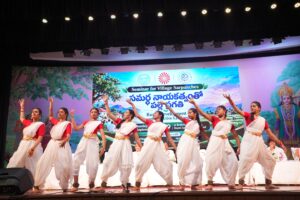
Seethakka Highlights Role of Sarpanches in Rural Development
Speaking at the programme, Minister Seethakka underlined the important role played by Sarpanches in the development of villages. She said that comprehensive development becomes possible when elected representatives work with self-reflection, ethical values and a spirit of service.
Her message placed the focus on leadership that goes beyond the implementation of government schemes. At the village level, the Sarpanch often acts as an important link between the administration and local residents. A leadership approach based on responsibility and public service can therefore help build greater trust between the community and local governance institutions. “Sarpanch Training”
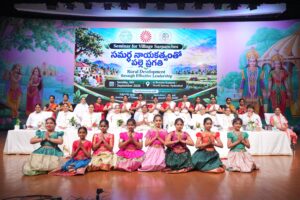
Value-Based Governance at the Centre of Training
A major focus of the programme was value-based governance. The training highlighted the need for village representatives to make decisions while keeping public welfare, honesty, cooperation and social harmony in mind.
The organisers emphasised that leadership becomes more effective when it is supported by inner discipline and clarity of thought. Self-reflection can help public representatives understand their own strengths, limitations and responsibilities, while ethical values can provide a framework for making decisions in the larger interest of the village community.
Rajyogini Santosh Didi Calls for Selfless Public Service
Rajyogini Santosh Didi urged the Sarpanches to approach public service with a selfless attitude. She stressed that elected representatives should consider their responsibility as an opportunity to serve people rather than merely as an administrative position.
The emphasis on service and compassion was closely linked to the broader objective of the programme, which sought to encourage leaders to develop a people-centric approach. When village representatives understand the needs of residents and work with a sense of collective responsibility, governance can become more participatory and responsive.
Focus on Sustainable and Yogic Agriculture
The programme also touched upon the importance of agriculture in rural development. BK Sumant spoke about the significance of Sattvic Yogic Agriculture, highlighting an approach that connects agricultural practices with positive thinking, awareness and a balanced lifestyle.
Agriculture remains an important part of the rural economy, and discussions around sustainable farming can become particularly relevant for village leadership. By creating greater awareness about responsible agricultural practices and rural livelihoods, local leaders can contribute to broader efforts aimed at strengthening village-level development.
Rajyog as a Tool for Responsible Leadership
Telangana Coordinator Brahma Kumari Arundhati Akka said that Rajyoga can help develop Sarpanches as responsible leaders. She encouraged the village representatives to work with love, harmony and a sense of belonging towards the people they serve.
The message was based on the idea that effective leadership requires not only administrative knowledge but also emotional balance and the ability to maintain constructive relationships with the community. Treating villagers as one’s own people and creating an atmosphere of cooperation can help local leadership address challenges more effectively.
Shanti Sarovar Leadership Initiative Receives Appreciation
Rajyogini Kuldeep Didi, Director of Shanti Sarovar, expressed happiness over the organisation of the programme and its focus on strengthening grassroots leadership. Shanti Sarovar in Hyderabad has previously hosted a range of educational, governmental and leadership-oriented programmes, with its facilities including seminar and auditorium spaces.
The venue provided a platform where elected village representatives from different parts of Telangana could come together, exchange perspectives and participate in sessions focused on leadership and rural development.
PR&RD CEO Divya Appreciates Brahma Kumaris’ Contribution
PR&RD CEO Divya also participated in the programme and appreciated the initiative. She acknowledged the contribution of Brahma Kumaris towards community-oriented activities and described their services as memorable.
Her participation also highlighted the importance of collaboration between government institutions and organisations working in the areas of social development, leadership and community empowerment. Such cooperation can help create additional platforms for capacity building among grassroots representatives.
Leadership Can Strengthen Village Development
The programme highlighted a broader issue facing rural governance: development at the village level depends not only on government schemes and financial resources but also on the ability of local leadership to mobilise communities and coordinate different development efforts. Rural development frameworks similarly place importance on effective leadership, community participation, coordination and capacity building for village-level development.
For Sarpanches, leadership training can therefore provide an opportunity to understand how planning, communication, community participation and responsible decision-making can work together. When these elements are combined with transparency and a service-oriented approach, village institutions can become more effective in responding to local needs.
A New Emphasis on People-Centred Rural Governance
The Hyderabad programme brought together spirituality, leadership development and rural governance on a common platform. The central message was that village progress requires leaders who can combine administrative responsibility with ethical conduct, empathy and a willingness to work collectively.
With around 500 Sarpanches participating, the “Village Progress through Effective Leadership” programme sought to create greater awareness about the responsibilities of grassroots leaders and the importance of value-based governance. The initiative also underlined that sustainable rural development ultimately depends on capable local leadership and active participation from the community.