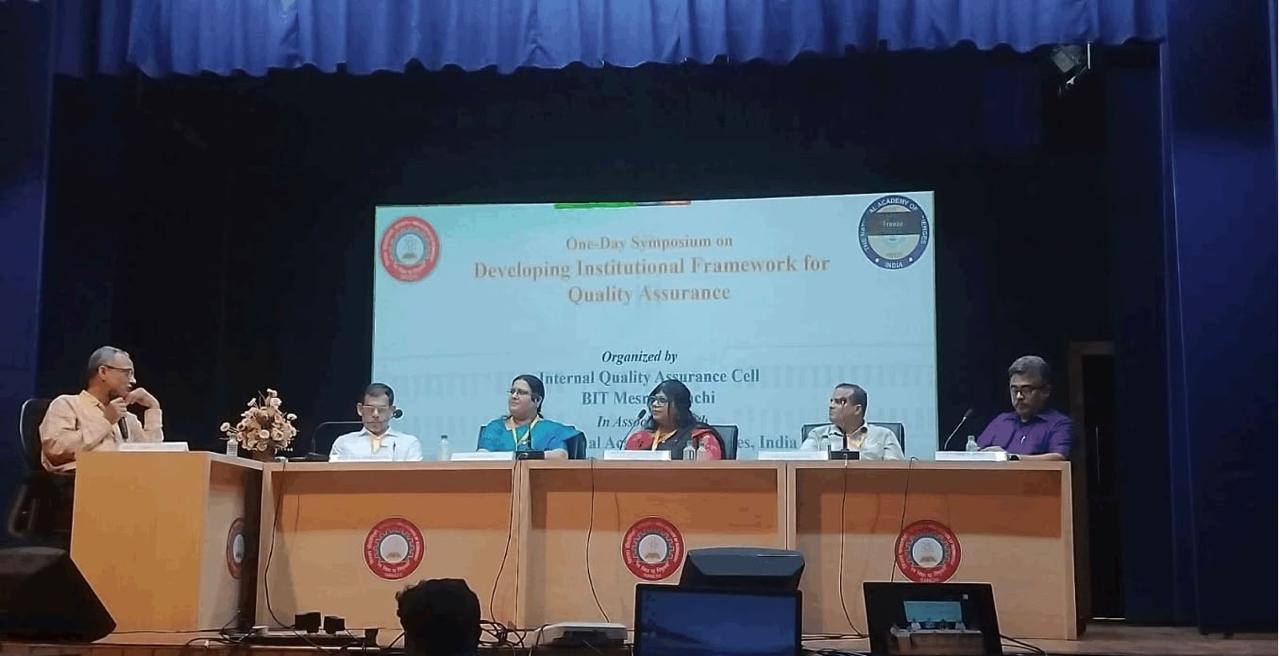
In an era where higher education institutions are increasingly expected to meet global standards of academic excellence, innovation, and accountability, Birla Institute of Technology (BIT) Mesra took a significant step by organizing a One-Day National Symposium on “Developing Institutional Framework for Quality Assurance.” The event, jointly organized by the Internal Quality Assurance Cell (IQAC), BIT Mesra, and the National Academy of Sciences, India (Jharkhand Chapter), served as a vital platform for academicians, researchers, quality assurance experts, administrators, and policymakers to deliberate on the future of quality enhancement in Indian higher education.
The symposium focused on several transformative themes, including accreditation, Outcome-Based Education (OBE), the implementation of the National Education Policy (NEP) 2020, NAAC and NBA quality frameworks, sustainability, and institutional excellence. The discussions reflected the growing importance of building educational institutions that are not only academically strong but also socially relevant, globally competitive, and committed to continuous improvement.
BIT Mesra Reinforces Its Commitment to Academic Excellence
The symposium was inaugurated in the presence of distinguished academicians and education leaders. The inaugural session was graced by Prof. Indranil Manna, Vice Chancellor of BIT Mesra, who emphasized the importance of establishing robust quality assurance systems to ensure that educational institutions remain responsive to changing societal needs and global educational standards.
The event was honoured by the presence of Prof. M. S. Dasgupta, Senior Professor and Coordinator of IQAC at BITS Pilani, who attended as the Chief Guest. The symposium was chaired by Prof. Animesh Ghosh, Director of IQAC, BIT Mesra, whose leadership has been instrumental in promoting quality culture across the institution. Their collective presence highlighted the significance of institutional collaboration in strengthening India’s higher education ecosystem.
Why Quality Assurance Has Become the Cornerstone of Higher Education
Quality assurance has emerged as one of the defining pillars of modern higher education. Universities today are no longer evaluated solely on academic performance but also on governance, innovation, research productivity, employability, industry collaboration, student satisfaction, and social impact. The symposium explored how institutions can create sustainable internal mechanisms that continuously monitor, evaluate, and improve academic and administrative performance.
Experts discussed how accreditation frameworks such as NAAC and NBA should not be viewed merely as compliance exercises but as strategic tools that encourage institutions to pursue excellence. They stressed that quality assurance is an ongoing journey requiring commitment from leadership, faculty members, students, and administrators alike.
Outcome-Based Education: Preparing Students for the Future
One of the central themes of the symposium was Outcome-Based Education (OBE), an educational model that focuses on measurable learning outcomes rather than traditional teaching methods. Speakers explained that OBE encourages institutions to design curricula around the knowledge, skills, and competencies students are expected to acquire by the end of their academic programmes.
The discussions highlighted that successful implementation of Outcome-Based Education strengthens graduate employability, promotes interdisciplinary learning, enhances practical skills, and aligns academic programmes with industry requirements. Participants agreed that OBE has become essential for preparing graduates capable of addressing complex global challenges and contributing meaningfully to society.
NEP 2020 Driving Educational Transformation
The symposium devoted considerable attention to the implementation of India’s National Education Policy (NEP) 2020, which seeks to transform the country’s higher education landscape through multidisciplinary learning, flexibility, innovation, digital integration, research promotion, and internationalization.
Experts observed that NEP 2020 offers institutions an unprecedented opportunity to redesign academic programmes while fostering critical thinking, creativity, entrepreneurship, and lifelong learning. Discussions also focused on the institutional reforms necessary to successfully implement the policy, emphasizing the importance of strong governance structures, faculty development, technological infrastructure, and effective quality assurance mechanisms.
Learning from National Experts
The technical sessions featured insightful lectures delivered by renowned academicians including Prof. M. S. Dasgupta, Prof. Shilpa Pal, Prof. Paromita Chakraborty, and Prof. Tapan Kumar Basantia. Their presentations examined various dimensions of institutional quality, accreditation practices, curriculum innovation, sustainable education, and best practices adopted by leading universities.
Each speaker shared practical experiences and evidence-based strategies that educational institutions can adopt to strengthen their internal quality assurance systems. The sessions encouraged participants to move beyond conventional approaches and embrace continuous innovation in teaching, research, governance, and institutional management.
Accreditation Beyond Rankings
A major highlight of the symposium was the panel discussion titled “The Impact of Accreditation of Higher Educational Institutions on Science and Society.” The discussion brought together eminent speakers along with Prof. Sudip Das of BIT Mesra, creating an engaging dialogue on the broader significance of accreditation.
Panelists argued that accreditation should not be perceived simply as a mechanism for institutional ranking. Instead, it serves as an important instrument for improving educational quality, strengthening public trust, enhancing research productivity, promoting ethical governance, and creating socially responsible institutions. They emphasized that quality education ultimately contributes to scientific progress, technological innovation, economic development, and national growth.
A Gathering of Educational Leaders
The symposium attracted nearly 140 participants, representing a diverse cross-section of India’s academic community. Faculty members, researchers, IQAC coordinators, NAAC and NBA experts, institutional administrators, and education professionals from BIT Mesra, its off-campuses, University Polytechnic, NIAMT, Ranchi University, Sarala Birla University, Usha Martin University, and several other higher education institutions actively participated in the event.
The broad participation reflected the growing recognition that quality assurance is a shared responsibility requiring collaboration across institutions. The exchange of ideas among experienced academicians and emerging educators created valuable networking opportunities and encouraged future collaborations in quality enhancement initiatives.
Building a Culture of Continuous Improvement
The symposium was successfully convened by Dr. Alok Jain and Dr. Tanushree Bhattacharya, whose efforts ensured meaningful discussions and active participation throughout the programme. Beyond formal presentations, the event promoted open dialogue on the challenges and opportunities facing higher education institutions in implementing quality assurance systems.
Participants explored innovative approaches to faculty development, institutional governance, student engagement, curriculum design, research quality, and sustainable academic practices. The emphasis remained on building institutional cultures where quality becomes an integral part of everyday academic and administrative functioning rather than a periodic exercise driven by accreditation cycles.
BIT Mesra’s Vision for Future-Ready Institutions
By organizing this national symposium, BIT Mesra reaffirmed its commitment to academic excellence, institutional innovation, and continuous quality enhancement. The discussions highlighted that universities must evolve beyond traditional teaching centres into dynamic institutions capable of generating knowledge, fostering innovation, promoting ethical leadership, and addressing societal challenges.
As India’s higher education system undergoes significant transformation under NEP 2020, initiatives such as this symposium play an important role in equipping educational leaders with the knowledge, strategies, and collaborative networks necessary for achieving sustainable excellence. The event reinforced the idea that quality assurance is not an endpoint but a continuous process that shapes institutional growth, student success, and national development.
Conclusion
The One-Day Symposium on “Developing Institutional Framework for Quality Assurance” successfully demonstrated that the future of higher education lies in embracing innovation, accountability, collaboration, and continuous improvement. By bringing together distinguished academicians, quality assurance experts, and institutional leaders, BIT Mesra created a meaningful platform for exchanging ideas that will contribute to stronger educational institutions across India.
The symposium concluded with a shared commitment to building a higher education ecosystem where quality is embedded in every aspect of institutional functioning—from governance and curriculum to research, student learning, and community engagement. Such initiatives not only strengthen individual institutions but also contribute significantly to India’s aspiration of becoming a global knowledge leader.