BIT Mesra Researcher Honoured at URSI GASS 2026
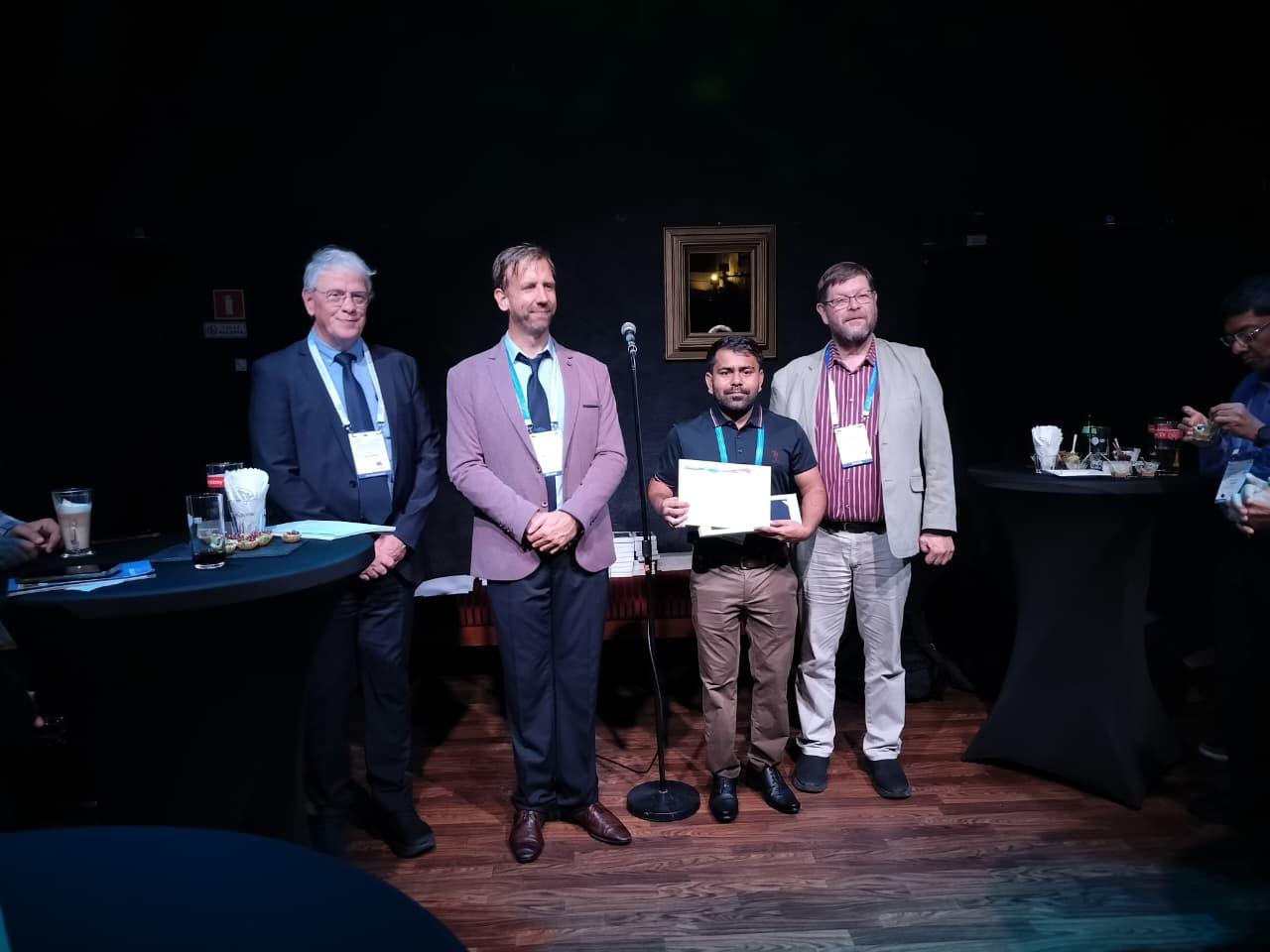
Nitish Kumar, a researcher in the Department of Remote Sensing and Geoinformatics at Birla Institute of Technology, Mesra, has been honoured with the prestigious Young Scientist Award at the URSI General Assembly and Scientific Symposium, URSI GASS 2026, held in Kraków, Poland. The recognition marks an important achievement for the young researcher and highlights the growing contribution of Indian researchers to advanced remote sensing, radar technology and planetary science. Kumar received the award for his research titled “Ejecta Characterization of an Icy Crater Using Chandrayaan-2 Dual-Frequency Synthetic Aperture Radar,” which focuses on the study of lunar terrain using observations from India’s Chandrayaan-2 mission. “BIT Mesra Researcher”
Research Linked to Chandrayaan-2 Lunar Mission
The award-winning research is centred on the characterisation of ejecta associated with an icy crater in the lunar south polar region. The study makes use of dual-frequency Synthetic Aperture Radar observations obtained through the Chandrayaan-2 mission. By analysing radar observations and advanced polarimetric parameters, the research seeks to understand the physical characteristics of material surrounding an icy crater. Such studies are particularly significant for lunar science because the south polar region of the Moon is considered an important area for understanding the lunar surface, subsurface characteristics and the distribution of volatile materials. “BIT Mesra Researcher”
Advanced SAR Technology Used to Study the Moon
Synthetic Aperture Radar, commonly known as SAR, is a powerful remote sensing technology that can provide information about the surface of planetary bodies by analysing radar signals. Unlike conventional optical observations, radar-based techniques can provide valuable information under different illumination conditions and can help researchers investigate surface characteristics that may not be easily identified through optical imagery alone. Nitish Kumar’s research applies dual-frequency SAR observations along with advanced polarimetric analysis to examine the characteristics of lunar ejecta, demonstrating how radar remote sensing can support detailed planetary exploration. “BIT Mesra Researcher”
Focus on the Lunar South Polar Region
The lunar south polar region has emerged as one of the most scientifically significant areas in modern lunar research. The region has attracted considerable attention because of its unique terrain and the possibility of water ice and other volatile materials being preserved in permanently shadowed areas. Research based on Chandrayaan-2 observations can therefore contribute to a broader understanding of the Moon’s geological and surface environment. Kumar’s study focuses specifically on an icy crater and its associated ejecta, using radar-based observations to examine the characteristics of the lunar landscape. “BIT Mesra Researcher”
Research Conducted Under Chandrayaan-2 Programme
The research was undertaken as part of the Chandrayaan-2 research programme under the guidance of Principal Investigator Dr. V. S. Rathore and Co-Principal Investigator Dr. A. P. Krishna. Their guidance supported the research in applying advanced remote sensing techniques to planetary exploration. The study combines data from the Chandrayaan-2 mission with scientific methods involving radar observations and polarimetric parameters, reflecting the interdisciplinary nature of modern lunar research, where space science, remote sensing, geoinformatics and radar technology come together to analyse extraterrestrial terrain. “BIT Mesra Researcher”
International Recognition for Young Researcher
The Young Scientist Award at URSI GASS 2026 provides international recognition to Nitish Kumar’s work and places his research within a global scientific forum. URSI GASS brings together researchers and experts working across radio science and related areas, making the recognition significant for a researcher working in advanced radar remote sensing and planetary applications. The award demonstrates how specialised research conducted by young scientists can gain visibility on international platforms when it addresses emerging challenges and scientific questions in space and remote sensing.
Emerging International Research Collaboration
The recognition also highlights the growing international dimension of the research, including an emerging collaboration with Dr. Ajeet Kumar, a researcher at RaSS Lab, CNIT, Italy. The collaboration is focused on advanced radar remote sensing and planetary exploration and provides an international research perspective to the study of radar-based observations. Such collaborations can help researchers exchange scientific expertise, explore new methodologies and develop stronger research networks in specialised areas of space science and remote sensing. “BIT Mesra Researcher”
Importance of Polarimetric Analysis in Lunar Research
An important component of the research is the use of advanced polarimetric parameters to characterise lunar ejecta. Polarimetric analysis can provide additional information from radar signals and help researchers study differences in the physical properties and scattering behaviour of surface materials. When combined with dual-frequency SAR observations, these techniques can offer a more detailed understanding of lunar terrain. The approach used in Kumar’s research illustrates the increasing role of sophisticated radar analysis in planetary science and remote sensing-based exploration. “BIT Mesra Researcher”
BIT Mesra’s Research Contribution in Space Science
The achievement also reflects the research environment at Birla Institute of Technology, Mesra, where specialised work in remote sensing and geoinformatics is contributing to emerging scientific fields. Research connecting remote sensing technologies with planetary exploration demonstrates the expanding applications of geospatial science beyond Earth-based studies. The recognition of a BIT Mesra researcher at an international scientific symposium also brings visibility to the institute’s research activities and the potential of young Indian scientists working in advanced technological domains. “BIT Mesra Researcher”
Young Scientists and India’s Growing Space Research Ecosystem
The Young Scientist Award comes at a time when lunar exploration and space science have gained significant attention globally. India’s Chandrayaan missions have generated valuable scientific observations and opened new opportunities for researchers working on the Moon. Studies based on Chandrayaan-2 data allow scientists to investigate different aspects of the lunar surface using advanced technologies. Research such as Kumar’s demonstrates how mission data can continue to generate scientific value through specialised analysis long after the spacecraft has completed its primary mission objectives. “BIT Mesra Researcher”
A Recognition for Advanced Planetary Exploration Research
Nitish Kumar’s recognition at URSI GASS 2026 represents more than an individual academic achievement. It highlights the potential of advanced radar remote sensing and geoinformatics to contribute to planetary exploration. His work on icy crater ejecta using Chandrayaan-2 dual-frequency SAR demonstrates how sophisticated analysis of satellite and space mission data can help researchers investigate the Moon’s complex terrain. The Young Scientist Award therefore provides international visibility to both the research and the broader field of young scientific talent working in India on remote sensing, radar technology and space science. “BIT Mesra Researcher”